
Free written scope consultation - allowances, timeline, and change-order rules on paper before a single trade is scheduled
James Hardie Kitchen Remodeling: The Dallas Owner’s Guide
James Hardie kitchen remodeling in Dallas typically runs $14,000 to $45,000 depending on scope, cabinet grade, and whether walls need reconfiguration. We install HardieBacker cement board as the substrate standard on every kitchen we build in Dallas, because it holds up to the humidity swings this city throws at a kitchen better than gypsum-based board. Most homeowners land on this page because they’ve spotted cracked tile, a soft spot behind the sink, or water staining at the base of a cabinet and are trying to figure out how deep the problem goes.
Here’s the short version: if your existing kitchen has James Hardie cement board behind the tile and it’s failing, something underneath moved or moisture got where it shouldn’t have. That’s a repair we handle start to finish, and a written price is in your hands before any tools come off the truck.
Which James Hardie Models This Applies To
For kitchens, the James Hardie product that matters most is HardieBacker cement board, specifically the 500 and 800 series. The 500 is the standard quarter-inch board for floors and countertops; the 800 is the half-inch board we specify behind wall tile in shower surrounds and high-splash zones around ranges and sinks. The compatibility gotcha Dallas homeowners miss: HardieBacker 500 is not rated for wall use over studs, only over a solid substrate like plywood. If you see quarter-inch board screwed directly to wall studs, that was installed wrong from day one, and we see it regularly in flips throughout East Dallas and Mesquite.
When we tear out a failed James Hardie kitchen installation in Dallas, the original labels are usually long gone. That’s fine. Board thickness and fastener pattern tell us everything we need. On the OEM-versus-aftermarket question for HardieBacker specifically, there’s no meaningful aftermarket equivalent worth your money. HardieBacker is the spec-grade product, and because it’s a cement board rather than a consumable component, we install HardieBacker itself rather than substitute. For cabinetry and surfaces, we stock and install KraftMaid, Cambria, and Silestone alongside James Hardie’s cement board, so one crew handles the whole kitchen without three different vendors.
Styles & brands we work with







Signs Your James Hardie Kitchen Remodeling Is Failing
- Grout lines cracking in a stair-step pattern behind the sink or cooktop. That pattern usually means the HardieBacker underneath flexed, which happens when the board was installed over a joist span too wide for the tile assembly or when fasteners missed the framing. The fix is a proper tear-out and rebuild, not regrouting.
- Soft spots in the floor where the vinyl plank or tile dips underfoot. Cement board doesn’t rot, but the subfloor beneath it does. Water from a slow dishwasher leak or a failed ice-maker line soaks the wood, and the HardieBacker above gives way. We find this in older Dallas kitchens where supply lines were original to a 1970s or 80s build.
- Tiles popping loose whole, with a layer of gray cement board stuck to the back. That’s a bond failure between thin-set and board, common when the board wasn’t wiped down before tile set or the thin-set sat too long. The tile coming up with the board attached means moisture is pressing from behind.
- Discoloration bleeding through painted drywall at the HardieBacker seam line. If the installer taped seams with standard drywall tape instead of alkali-resistant mesh tape, the concrete in the board eats the tape over time and you get a visible ridge with staining. We see this more than we should in budget remodels across Oak Cliff.
- Base cabinets pulling away from the wall while the countertop drops at the back edge. The HardieBacker isn’t the direct cause; this is usually a wall framing or water issue, but the board hides it until the cabinet is loose enough to notice. By the time you see daylight behind the cabinet, you’re past silicone-and-caulk territory.
See the difference
 Before
 After
After Before
 After
After Before
 After
AfterReplacement Cost & What’s Included
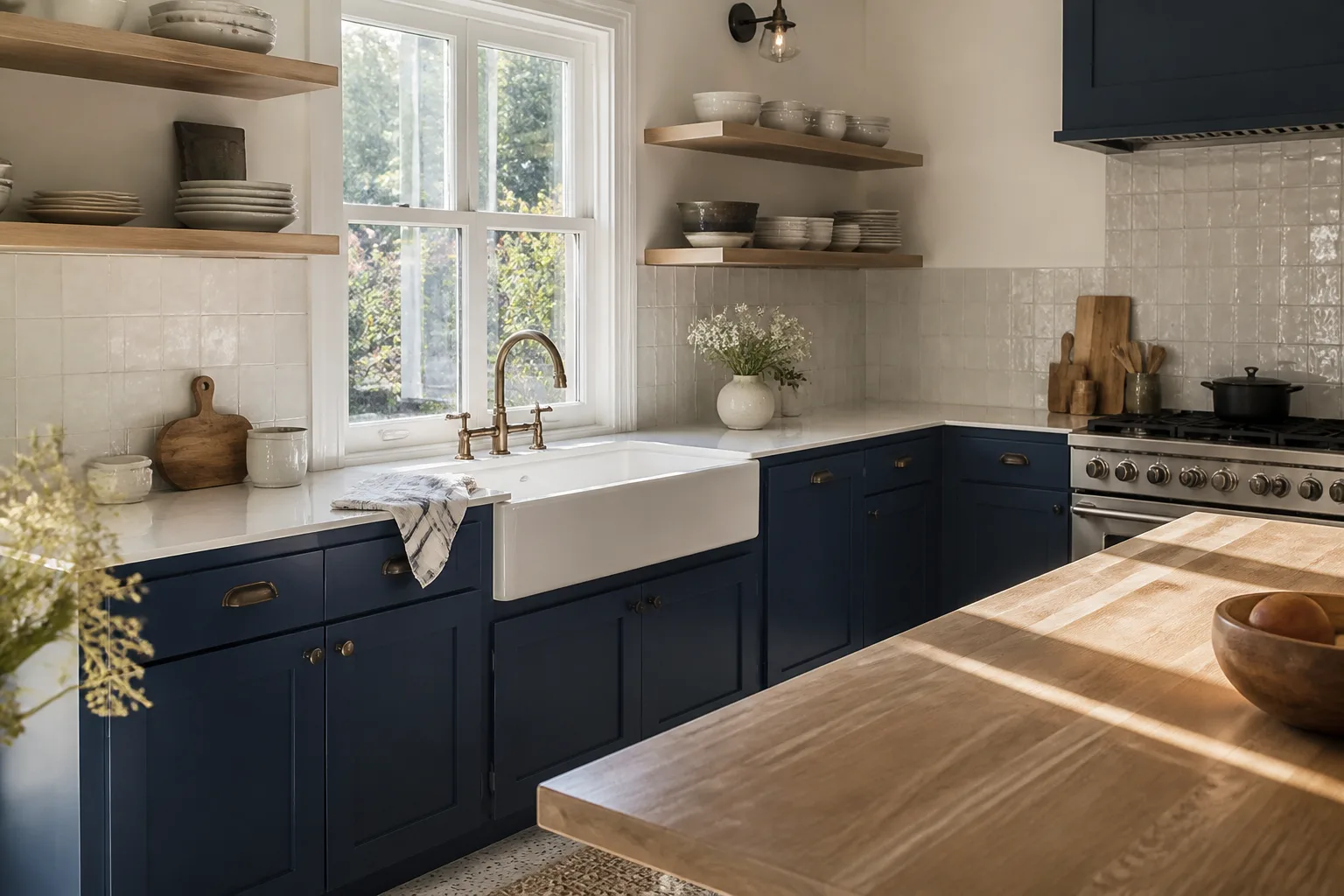
Installed James Hardie kitchen remodeling in Dallas lands between $14,000 and $45,000. On the low end, that’s a floor-to-ceiling refresh: HardieBacker repair or replacement in the splash and wet zones, new flooring substrate, paint, and hardware. On the high end, you’re reconfiguring walls, moving the sink run, and rebuilding the entire wet wall with new plumbing stub-outs behind HardieBacker 800
What drives the spread more than anything in Dallas is what’s hiding in the walls. A 1960s ranch in Lakewood with original cast-iron drain lines and cloth-wrapped wiring is a different job than a 2010s build in Frisco with PEX and Romex. We price both honestly, and the written price we deliver before work starts includes the demolition, the board, the tile work, the cabinetry, the countertop, and the plumbing and electrical permits. No change orders because we found something we should have caught on the walkthrough. Isaac Pruett still walks every job himself before the first nail goes in, and that’s when we catch most surprises, not after tear-out.
Every kitchen remodel we complete is covered by our 365-Day Done Right Promise. If something isn’t right within a year of the completion date, we return and make it right at no cost. That’s stated in the written guarantee, including what’s covered and what’s excluded. No fine-print scavenger hunt.
DIY or Call Us?
If you suspect a HardieBacker failure in your Dallas kitchen, there are safe things you can check yourself. Look at the grout lines with a flashlight. Press along the wet wall behind the sink to feel for deflection. Check under the sink cabinet with the doors open for moisture smells or staining. That tells you enough to know whether you need a pro in the house.
What you shouldn’t do is start pulling tile or cutting into board to find the leak. If you hit a supply line hidden in the wall, you’ve turned a $400 repair into a four-figure water damage claim before you can shut the main off. And if the framing behind the board is compromised, you need someone who understands load paths before they remove material that’s holding the wall shape. We’re not going to scare you, but we are going to be straight: this is where DIY remodels stall and get expensive. You should know who is coming, what it costs, and what happens if something goes wrong, before we ever pick up a tool. Call us at (432) 302-8761 and we’ll put a written price in your hands before anything gets torn out.
FAQs
HardieBacker itself doesn’t rot or degrade under normal conditions; it’s the installation and the materials around it that fail, usually within 10 to 15 years if water gets in or the subfloor moves. In Dallas, the bigger variable is foundation movement in clay soil areas like Richardson and Garland, which stresses tile assemblies faster than the board itself. Call (432) 302-8761 if you’re seeing cracks and want an honest read on whether it’s the board or the house.
Small sections can be cut out and patched if the surrounding board is still sound and dry, but the critical question is always what caused the failure. If water got behind the board, a patch without fixing the moisture source means you’ll see us again next year and the year after. We’ll tell you which situation you have, and the estimate is free.
A full wet-wall rebuild with new HardieBacker, tile, cabinets, and countertops usually runs three to five weeks from demo to final walkthrough, depending on scope and what the walls reveal. We give you a written timeline with the written price, so you’re not guessing when the sink comes back online. Call (432) 302-8761 for a timeline based on your actual kitchen.
We stock HardieBacker 500 and HardieBacker 800 on the truck for standard installations, and we order the full James Hardie line through our supplier network for Dallas-area jobs with specialty needs. We also stock and install KraftMaid cabinetry and Cambria and Silestone surfaces, so your kitchen doesn’t stall waiting on three different supply chains. Call (432) 302-8761 and we’ll confirm what’s in stock before your estimate.
Written by Isaac Pruett, Owner, Mason Remodeling Co Dallas at Mason Remodeling Co Dallas, serving Dallas and nearby areas.


